
Match-Fixing in Australian Football: A Sports Law Perspective
Recent match-fixing allegations in Australian football, particularly the “yellow card scandal,” have reignited debates surrounding sports law, encompassing disciplinary measures, criminal law, and international cooperation. This study examines the current legal framework in Australia, evaluates the potential benefits of the Macolin Convention, and offers a comparative analysis with Portugal and France. The paper highlights the challenges and opportunities for aligning Australian sports law with international standards.
Introduction
The integrity of sports competitions is a fundamental principle of sports law. Match-fixing represents one of the most severe threats to this integrity. The recent “yellow card scandal” in Australian football has drawn attention to both ethical and legal dimensions. Licensed betting operators reported unusual odds movements to law enforcement, demonstrating the role of private actors in maintaining public order. This case highlights the intersection between disciplinary law, criminal law, and international regulation.
Legal Dimensions of Match-Fixing
–Disciplinary Law
FIFA’s Disciplinary Code (Art. 18) and UEFA’s Code of Ethics (Art. 12) impose severe sanctions for manipulation of sporting competitions. The Australian Football Federation similarly enforces long-term bans on players who compromise match integrity.
–Criminal Law
Match-fixing extends beyond sports disciplinary mechanisms. Under Australian state laws, fraudulent activity and organized crime provisions may apply, creating an overlap between sports law and criminal law. Criminal prosecution may include imprisonment and financial penalties.
International Framework and the ”Macolin Convention”
The Council of Europe’s 2014 Convention on the Manipulation of Sports Competitions (Macolin Convention) mandates cooperation among states, sports organizations, and betting operators.
- Article 5: Obliges states to implement preventive measures.
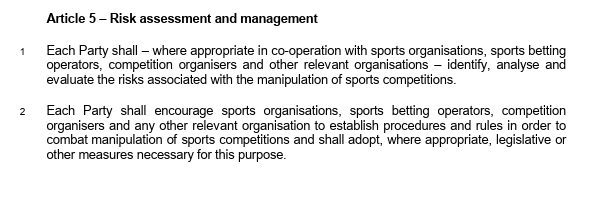
- Article 11: Mandates international cooperation between law enforcement authorities.

Australia has not yet ratified the Macolin Convention. The absence of a uniform federal regulation leads to inconsistencies across states, weakening the effectiveness of anti-match-fixing measures.
Comparative Legal Analysis
- Portugal: Law No. 14/2024 prescribes up to eight years of imprisonment for match-fixing, alongside disqualification from sporting duties and ineligibility for public funding.

- France: Penal Code, Article 445-1-1, criminalizes manipulation of sporting events and imposes legal penalties.
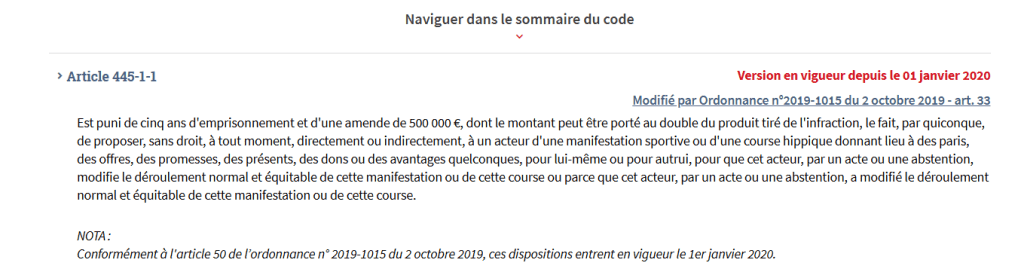
These examples provide potential models for legislative reform in Australia.
Conclusion
The recent match-fixing allegations in Australian football underscore the multidimensional nature of sports law. Effective regulation requires:
- Comprehensive federal legislation,
- Ratification of the Macolin Convention,
- Coordinated efforts among sports federations, betting operators, and law enforcement.
Without such measures, match-fixing scandals will continue to undermine not only athletes’ careers but also public confidence in sports.
From a personal analytical perspective, the recent match-fixing allegations in Australian football illustrate not only the vulnerability of sports to manipulative practices but also the broader systemic challenges facing national and international sports governance. While disciplinary codes and criminal statutes provide a framework for punitive measures, the effectiveness of these instruments is contingent upon robust enforcement mechanisms and comprehensive regulatory alignment across jurisdictions. Australia’s current absence from the Macolin Convention exposes a significant gap in its capacity to engage in coordinated international action, leaving both athletes and federations susceptible to reputational and legal risks. Comparative examples from Portugal and France suggest that integrating criminal sanctions with administrative and sporting penalties can enhance deterrence; however, such measures must be accompanied by proactive education programs for athletes, transparent governance structures within federations, and real-time monitoring by betting regulators. Personally, I perceive this incident as a critical juncture that underscores the need for Australia to transition from reactive enforcement to a preventive, integrity-centered model. Only through embracing international best practices and cultivating a culture of accountability within all levels of sport can the country safeguard the legitimacy of its competitions and restore public confidence. Ultimately, the scandal demonstrates that sports law cannot exist in isolation: it must intersect strategically with ethics, governance, and criminal justice to effectively uphold the principles of fairness and integrity in contemporary sport.
References
- Council of Europe, Convention on the Manipulation of Sports Competitions (Macolin Convention), CETS No. 215, 2014.
- FIFA, FIFA Disciplinary Code, 2023.
- UEFA, UEFA Ethics and Disciplinary Regulations, 2022.
- Portugal, Law No. 14/2024 on Integrity in Sport, Diário da República, 19 January 2024.
- France, Penal Code, Article 445-1-1.
- Interpol & Europol, Match-Fixing Report, 2023.
- The Guardian, “The world betting game: is football more susceptible to match-fixing in Australia?”, 21 August 2025.
Av. Bilge Kaan ÖZKAN 'ın kaleminden.. sitesinden daha fazla şey keşfedin
Son gönderilerin e-postanıza gönderilmesi için abone olun.
